
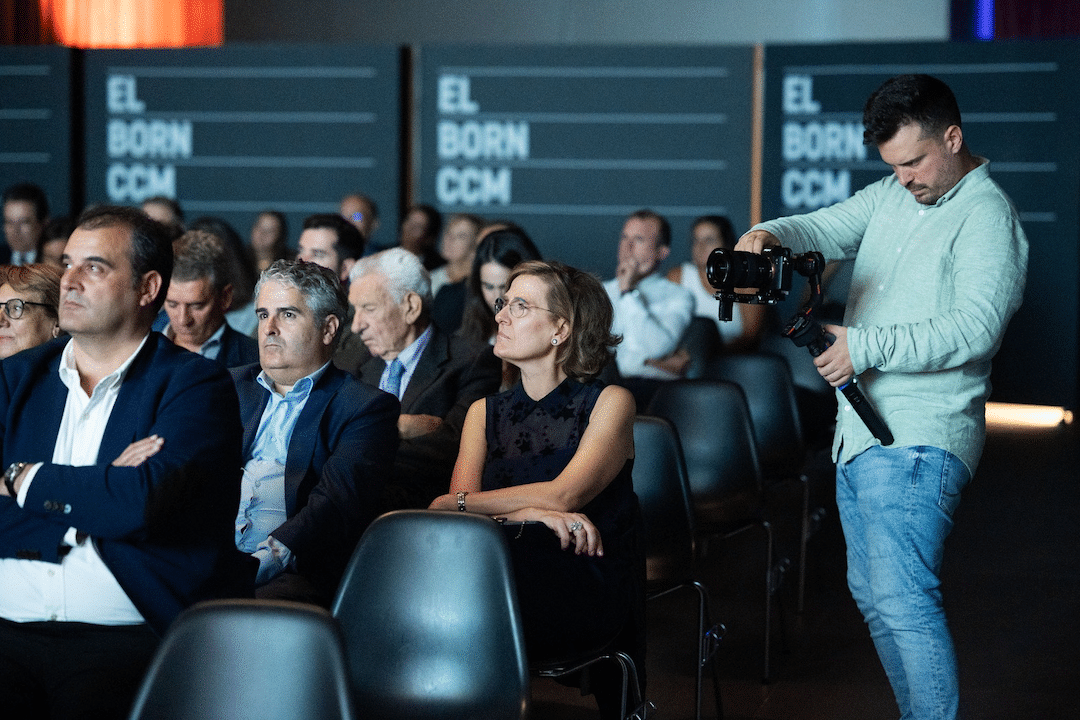
An aftermovie is a short video that sums up an event with footage of the venue, the people who attended and the key moments. It can run on music and ambient sound alone, or include short soundbites from speakers and attendees. If you organise congresses, trade fairs or product launches for a company, it is the piece you will send to attendees, show to sponsors and post on social media for weeks, and one of the most requested deliverables when we film an event in Barcelona. Here is what is worth knowing before you order one: how long it should be depending on where you publish it, what has to be filmed, what else comes out of the same day, when you will get it and what drives the price.
What an aftermovie is, and what it is not
The word comes from music festivals, where the aftermovie is almost a trailer for next year’s edition. At a corporate event it does the same job in a different tone: it proves the event happened, the room was full and people left happy. It is not the recording of the talks (that is a separate piece), nor an institutional video with a voice-over, nor a collection of shots of the catering. It is a short story with a beginning, a middle and an end: how it was set up, how it kicked off, what happened and how it closed.
What sets it apart from any other event video is that it is decided before filming. A camera operator who arrives without knowing what the piece is for films the stage; one who knows the aftermovie is going to social media and to sponsors films the audience, the branding details and the corridors.
How long an aftermovie should be, depending on where you will use it
There is no single right length; there is a length for each use, and it is common to deliver more than one version:
- 30 to 45 seconds, vertical, for Instagram, TikTok or LinkedIn. Usually the first thing published and the one that travels furthest.
- 60 to 90 seconds, horizontal, for the website, the follow-up email to attendees and the pitch for the next edition. This is the “official” aftermovie.
- Two to three minutes with soundbites from speakers, organisers or attendees, when the piece is aimed at sponsors or the annual report. Here people do speak, in short sentences over the music.
If you are only making one, make the 60 to 90 second version and ask for the shoot to be planned so the vertical cut can be made afterwards: framing that survives the crop and tight shots where the action sits in the centre of the frame.
What has to be filmed for an aftermovie people watch to the end
Editing cannot fix an event where the audience, the sponsors or the closing are missing. At a congress or a trade fair we film, in this order:
- Set-up and preparations: the empty room, the team placing signage, the sound check. Those are the ten seconds that give the video the feeling that something happened here.
- Arrivals and registration: the queue, the greetings, the first coffees. It is the shot event agencies use most to sell the next edition.
- The room from the back, with the speaker on screen and the audience’s heads in the foreground. One shot that places the speaker, the size of the room and the turnout in a single image.
- Speakers in close-up, at the moments of gesture: a laugh, a raised hand, the audience nodding.
- The audience reacting: applause, people taking notes, someone taking a photo with their phone. Without audience shots, the video looks like a recording of a lectern.
- The corridors: that is where the greetings, the stand demos and the conversations that never reach the stage take place. The operator has to move handheld and without getting in the way.
- Branding and sponsor details: the logo on the screen, the photocall, the bag, the badge. If a sponsor pays, it has to appear, and better woven in than stuck on for twenty seconds at the start.
- The ending: closing applause, the group photo, the room emptying. An aftermovie that ends on the last speaker feels cut off.
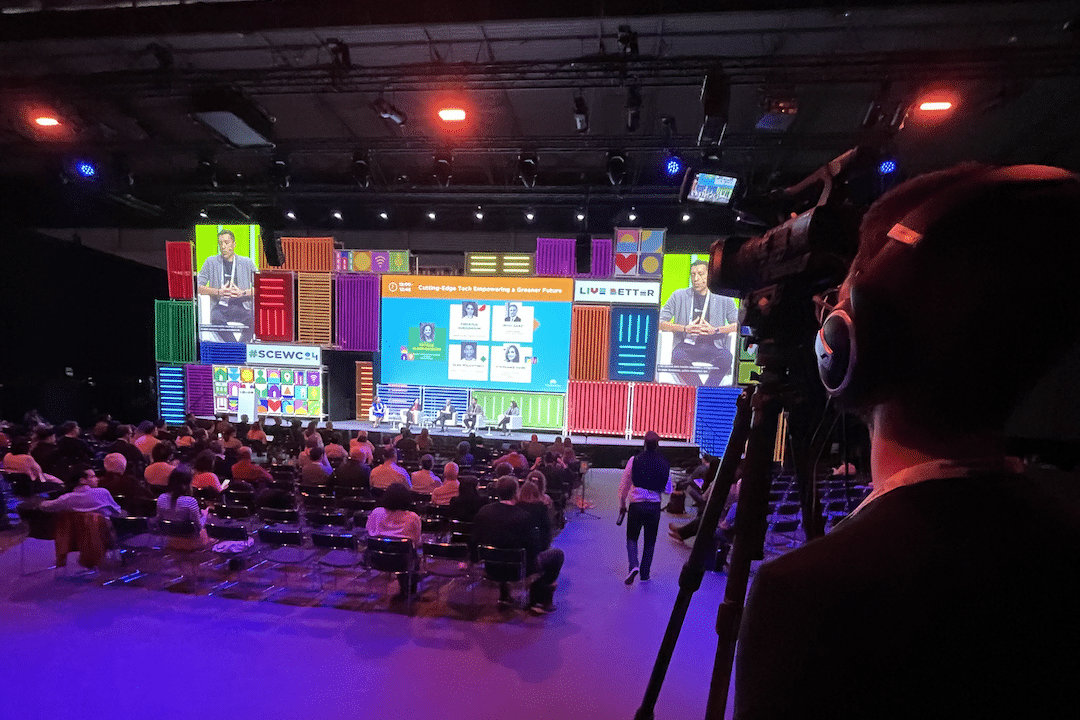
And one detail that is often forgotten: ambient sound. Even if the piece runs on music, recording applause, laughter and the murmur of the room lets them come through underneath at two or three points. It is what keeps it from feeling like an advert.
What to decide before the event
Most aftermovie problems are avoided in a half-hour meeting before the event, not in the edit suite. What we need to know:
- What it is for: selling the next edition, reporting back to sponsors, internal communication, social media. It changes what gets filmed and how long it runs.
- Who should appear and who should not, and how attendees will be told that filming is taking place. If some guests do not want to be on camera, we need to know before, not in the edit.
- Which brands have to be visible and how prominently. If there is a main sponsor, their presence is filmed deliberately.
- The programme: if two rooms run at the same time, one operator cannot cover both, so you need to decide which moments are essential.
- Sound: ask in advance for a feed from the sound desk, the venue technician’s contact and the running order with timings.
- Where it will be published: this sets the formats (horizontal, vertical, with or without subtitles) and the languages. In Barcelona it is common to ask for captions in Catalan and Spanish, and at international congresses in English as well.
- The music: licensed library music or an original piece. A commercial track must not be published without the proper licence, and social platforms detect it.
- The delivery date for each piece, and who approves the edit.
If the event is yours but the production company is hired by an agency, it is worth holding that meeting together: the agency wants to show its work and you want to show yours, and they are not always the same shots. What we ask for on any shoot is explained in how to prepare a brief for a video (in Spanish).
What else comes out of the same day
If you are already bringing a crew in, decide before the shoot which other pieces you need. From the same day, with planning, you can get:
- The full talks or presentations, recorded with a fixed camera and desk sound, for those who could not attend or for internal training.
- Vertical clips for social media: a five-minute interview with a speaker or an attendee yields two or three pieces under a minute. We explain how to turn an event into social media content (in Spanish).
- Soundbites from attendees and sponsors, which work as a testimonial video: they are already there and have just lived it.
- The live stream, if the event is broadcast. Some of the streaming footage can be reused, but the aftermovie usually needs a dedicated camera for the audience, the details and the corridors, because the live cameras are locked on the stage.
- The photo coverage, usually done by someone other than the video crew because the timings do not match. See event photography.
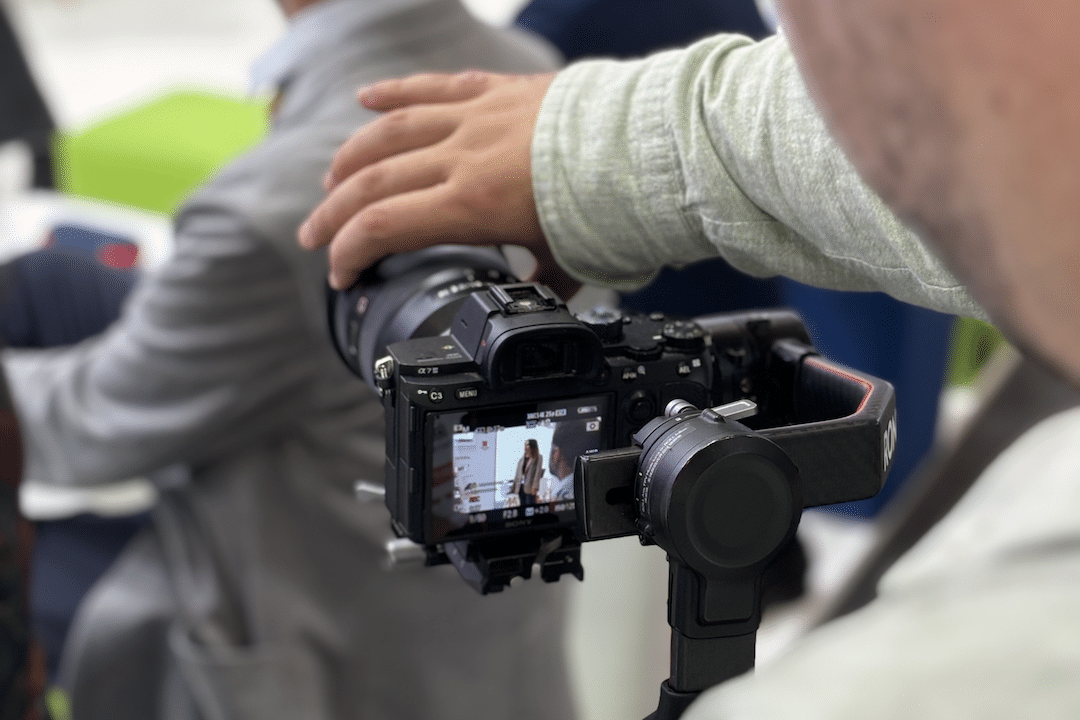
Planning avoids filming the same thing twice, but the number of cameras is set by what happens simultaneously: a one-day congress in a single room, with two operators, covers the aftermovie, the clips and the talks as long as the interviews do not clash with the essential moments; add a live stream and a second room and you need a third operator.
When you get it: the delivery order
The aftermovie is not the first thing delivered, and it is worth knowing that so you do not promise it in the closing speech. When fast publishing matters, this is the order we usually propose:
- Vertical clips, as soon as possible, because that is when attendees are sharing and the organisers are posting. If you need them the same day, it has to be booked that way: one person editing in the room while the event goes on.
- The 60 to 90 second aftermovie afterwards. Published turnaround times in the industry range from one to two working weeks; it depends on the hours of footage and the number of revisions.
- The full talks and the longer piece with soundbites last, because they take more editing and are usually less urgent.
At PlayFiction, photos and a very short clip can be ready the next day; the aftermovie usually takes about two weeks from the event, and if there is a fixed date that job goes to the front of the queue. The dates for each piece go in the quote, together with the number of revisions included.
What it costs to film an event and make the aftermovie
The price does not depend on how long the aftermovie is, but on what it takes to film it well. What moves it, from most to least:
- The hours of the event, and whether there is a set-up day before.
- The number of operators and cameras: one is enough for a session in a single room; a congress with corridors, stands and interviews running in parallel calls for two or three.
- Interviews: you need a corner with lighting and a microphone, and someone to conduct them.
- The deliverables: just the aftermovie, or clips, talks and photos as well.
- Extras: live streaming, same-day editing, subtitles and languages, or a drone when the venue, the regulations and the permits allow it.
- Urgency: a 48-hour delivery does not cost the same as a two-week one.
To compare quotes, check that they all state the same things: hours, cameras, deliverables, formats, revisions and dates. Two different figures are usually two different jobs. We explain in more detail what drives the price of any video in how much a corporate video costs (in Spanish).
Mistakes we see in corporate event aftermovies
- Too long. Four minutes is usually too much for social media and for the email to attendees.
- No audience. Ten shots of the stage and none of the room. It looks like a rehearsal.
- Twenty seconds of logo at the start. On social media, viewers have decided within three seconds. The brand is woven in, not put in front.
- Generic music at full volume and no real sound. You can tell.
- Horizontal version only. The official video goes on the website and social media is left without a piece of its own.
- Not filming the set-up or the ending. The story starts halfway and stops dead.
- Deciding everything afterwards. The editor cannot invent a shot that was never filmed.
Aftermovie for an event in Barcelona: how we do it
At PlayFiction we have been filming events for agencies and companies in Barcelona since 2015. The event projects published on our website include Women Congress Barcelona 2025, the Alimentaria trade fair for Estrella Galicia, the Mobile World Congress and Ron Barceló activations at Sala Bikini, and the method is the same for all of them: a meeting beforehand to decide what gets filmed and for whom, a crew that moves around the room without getting in the way, and delivery piece by piece. If you are organising an event, tell us the date and the programme and we will tell you what coverage is worth booking and what can come out of the day: request a quote for filming your event.